

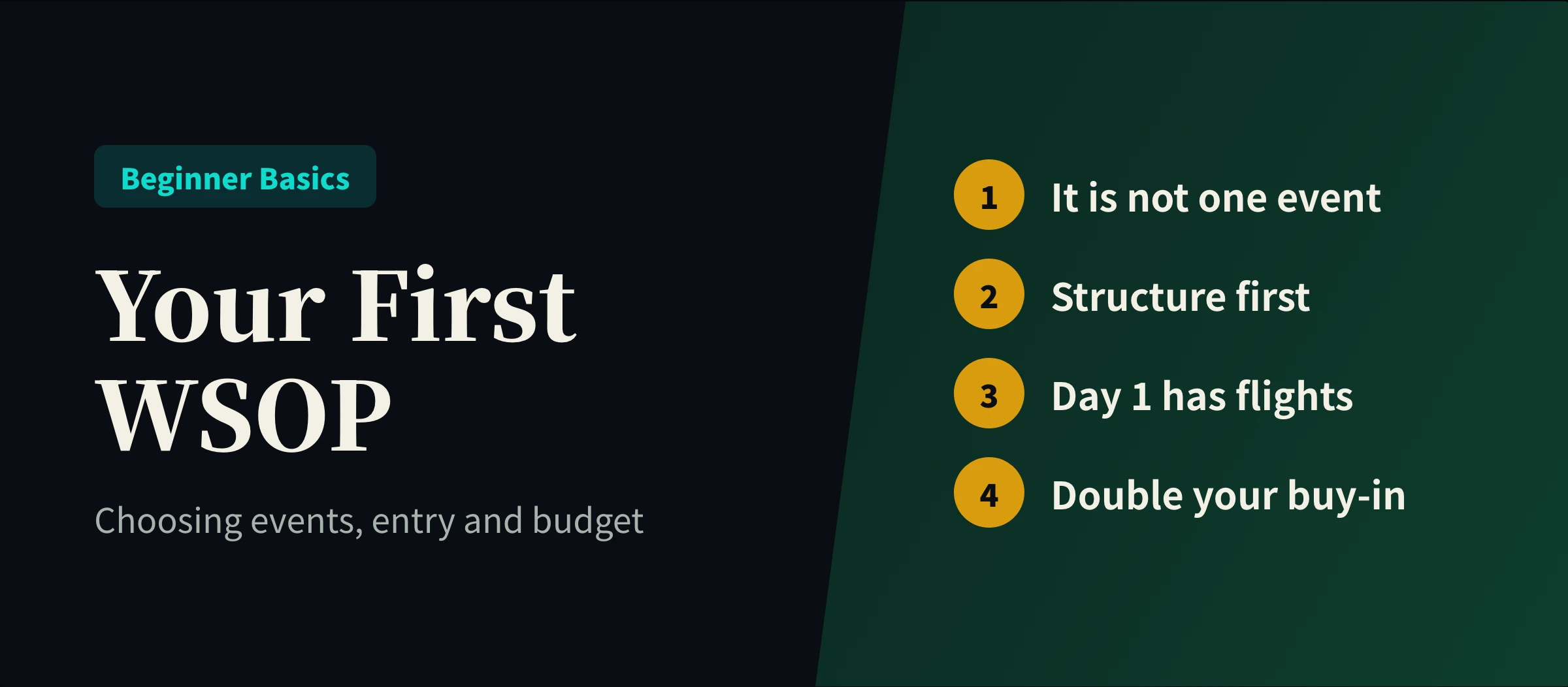
The WSOP is not a tournament. It is a summer of them — well over a hundred events, with buy-ins running from a few hundred dollars to five figures. The most common misconception among first-timers is that the trip means playing “the ten-thousand-dollar one”. Most people never do.
General travel preparation — documents, carrying cash, tax, jet lag — is covered in playing poker abroad. This page is about the WSOP itself.
- ✓The schedule holds over a hundred events; the Main Event is only one of them.
- ✓Choose by structure — level length and starting stack — before you look at the buy-in.
- ✓Large events split Day 1 into multiple flights; you play one of them, not all.
- ✓Budget at least double the buy-in. Room rates rise sharply during the series.
- ✓The schedule and rules are revised annually — confirm against the official site for the current year.
Reading the schedule
The official site publishes the full schedule each year. For each event, the things that matter are:
- Buy-in — anywhere from a few hundred dollars to the Main Event’s ten thousand.
- Game — No-Limit Hold’em dominates, but there is Omaha, mixed games and short deck.
- Structure — how long each blind level runs and how many chips you start with. This shapes the event far more than the buy-in does.
- Day 1 date and flights — larger events run Day 1A, 1B, 1C and so on.
For a first trip, look for a lower buy-in with a slower structure. Slow structures reward play over luck and make it far less likely you bust inside the first hour.
Why structure matters more than price
Two events at the same fifteen-hundred-dollar buy-in can be completely different tournaments: one starting with 25,000 chips and hour-long levels, the other with 7,500 and half-hour levels.
Look at two numbers:
- Starting stack divided by the big blind — how many big blinds you begin with. The deeper the effective stack, the more room there is to actually play.
- Level length — longer levels mean blind pressure builds slowly and skill has more time to matter.
Fast structures are cheaper to enter and get you into short-stack decisions quickly, which raises the luck component considerably. For a first WSOP, the slower event is both the better experience and the better lesson.
Registration and Day 1 flights
Registering can usually be done online or on site, and doing it early matters — queues during the series are long. You will need your original passport.
Day 1 flights are standard for the bigger events. The Main Event, for instance, splits Day 1 across several starting days; each player plays one, and survivors merge on Day 2. That means:
- You choose a flight, you do not play every day.
- Field sizes and table conditions differ between flights.
- Do not pick the flight that falls the day after you land.
Late registration is generally open until a stated level, and you receive the full starting stack. But arriving late means skipping the cheapest levels, so unless something forces it, there is no advantage.
Re-entry rules differ by event — some allow re-entering within a set window, others are single entry only. This directly caps your budget exposure, so check before registering.
What to actually budget
Budgeting only the buy-in guarantees an overspend. For a fifteen-hundred-dollar event with a week on the ground, real costs include:
- Buy-in — multiplied by how many re-entries you intend, if allowed
- Accommodation — rates rise during the series, and a week often costs as much as the buy-in
- Food and transport — several days of eating out
- Flights
- Contingency — an added event, an extended stay, the unexpected
A practical rule is to prepare at least twice the buy-in, with poker money kept separate from travel money. If losing this trip would affect your life when you get home, the buy-in level is too high.
Scheduling and stamina
WSOP days are long — typically hour-long levels and ten or more hours of play, with only short breaks.
- Do not stack consecutive days. Four or five in a row and your judgement will drop noticeably in the back half.
- Do not put Day 1 the morning after you land. You will play the most consequential day of the trip on no sleep.
- Leave rest days, particularly if you have a realistic chance of making Day 2 — those days run even longer.
